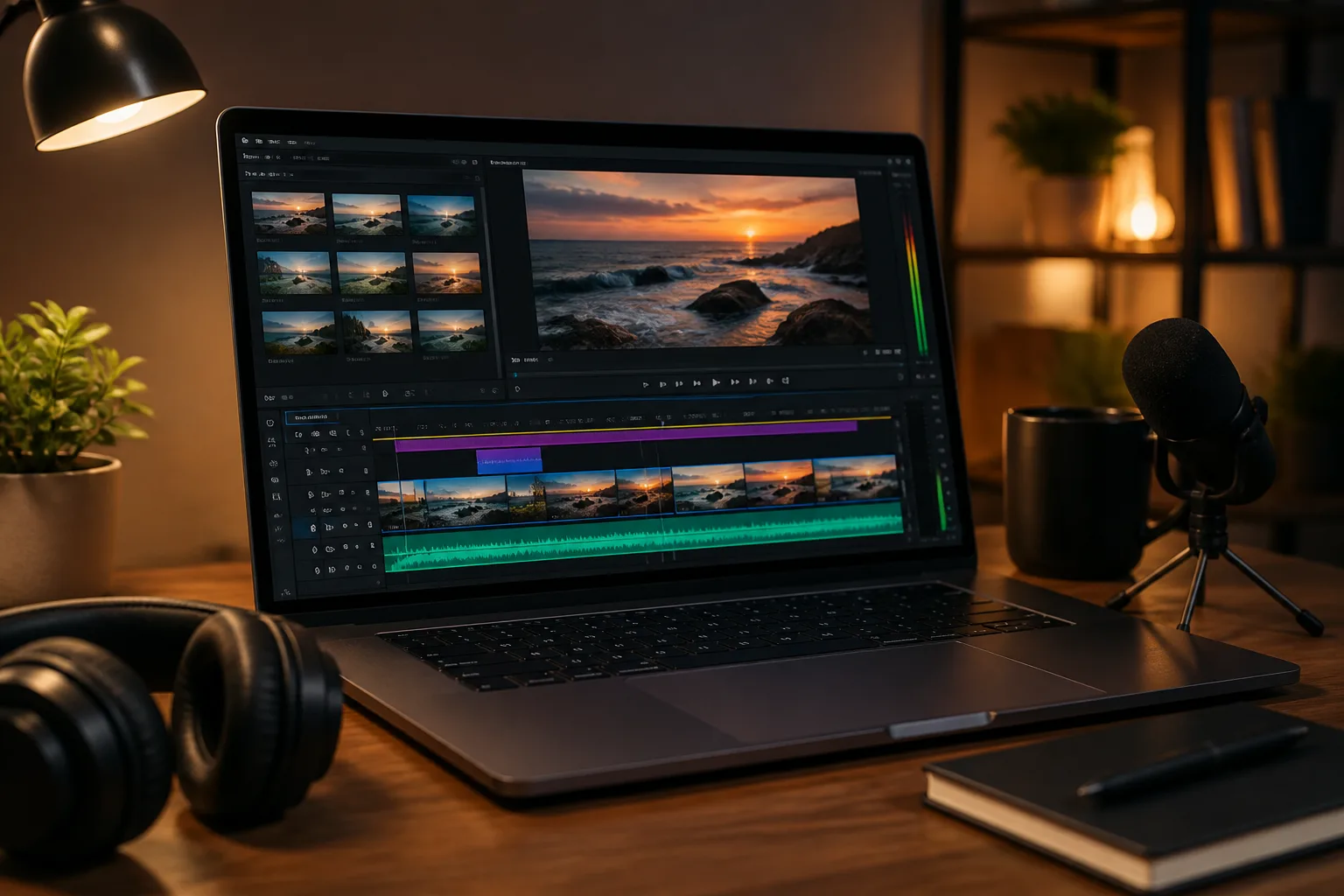

How to Edit YouTube Videos for Beginners Running Faceless Channels starts with a script, voice-over, subtitles, visuals, and editing, without an on-screen presence. Pictory and Fliki can convert scripts into faceless videos and generate captions. DaVinci Resolve’s free version supports exports up to 4K, though that capability doesn’t establish YouTube’s recommended export settings.
Channel facts
- Faceless videos can be created without an on-screen presence.
- Pictory and Fliki can convert scripts into faceless videos and generate captions.
- DaVinci Resolve’s free version supports exports up to 4K.
- Shotcut is open-source and watermark-free.
Your takeaways
- Prepare the script, voice-over, and visuals before assembling scenes.
- Check attribution and commercial-use licensing for visual assets.
- Review the hook and audience behavior, then adjust future edits.
- Follow YouTube’s recommended export settings, but don’t assume specific technical values from the available evidence.
How to Edit YouTube Videos for Beginners Running Faceless Channels?
A faceless YouTube video is created without an on-screen presence. For beginners, How to Edit YouTube Videos for Beginners Running Faceless Channels means building the video around a script, voice-over narration, subtitles, visuals, and editing rather than relying on a creator appearing on camera. The available evidence describes those production elements, but doesn’t detail other differences from on-camera editing.
Start by shaping the video script, then prepare its narration and visual material before editing the sequence. Script-to-video tools such as Pictory and Fliki can convert scripts into faceless videos and reduce production time.
Those tools also offer automatic caption generation and customizable templates. How to Edit YouTube Videos for Beginners Running Faceless Channels can therefore include assisted script conversion and captions, but the evidence doesn’t establish that either tool removes the need to review the finished edit. How to Edit YouTube Videos for Beginners Running Faceless Channels is a useful framing for a workflow centered on those documented steps.
Which beginner-friendly editing tools are available, and what do they cost?
Several documented editors have free options, while listed paid prices vary by product. For How to Edit YouTube Videos for Beginners Running Faceless Channels, compare the plan limits and prices in the table below rather than assuming every free editor has the same export features. The listed prices are not confirmed as current.
DaVinci Resolve’s free version is described as fully featured and supports exports up to 4K; Studio raises the export limit to 32K and adds tools such as noise reduction and AI effects. Studio’s listed typical price is approximately $295 one time.
ACDSee Luxea is free to use without watermarks or locked features, and is described as beginner-friendly. Lightworks’ free plan is limited to 720p exports. Shotcut is open-source and watermark-free, while Clipchamp supports watermark-free full HD exports.
Filmora is listed at approximately $50–$70 per year or approximately $100 one time; PowerDirector is listed at $54.99 per year. No prices are provided for every named tool, and the available claims don’t establish current pricing. How to Edit YouTube Videos for Beginners Running Faceless Channels starts with choosing a documented feature that fits your needs, not treating these figures as a live quote.
How to Edit YouTube videos for Beginners Running Faceless Channels should also account for what the evidence leaves unpriced: no cost per video is documented.
How can I find visuals, voice-over, and music without copyright claims?
Use visual and audio assets only after checking their licensing terms; the available evidence recommends sources and precautions but can’t guarantee that a particular asset will avoid a copyright claim. How to Edit YouTube Videos for Beginners Running Faceless Channels can draw on Pixabay and Pexels for images and videos, while checking whether attribution is required for each item.
Choose stock clips that match the video’s theme, and check licensing rights when using stock assets commercially.
Other listed visual options include stock footage, AI-generated images, and screen recordings. The evidence doesn’t assess B-roll or image slideshows specifically.
MicMonster and Fliki are described as offering access to over 2,000 human-like voices in multiple languages. Voice-overs can be adjusted for pitch, speed, and tone; no particular recording or AI text-to-speech settings are specified.
The source recommends royalty-free music from Epidemic Sound or the YouTube Audio Library. How to Edit YouTube Videos for Beginners Running Faceless Channels should include checking the terms for music and any sound effects before use. How to Edit YouTube Videos for Beginners Running Faceless Channels depends on verifying the individual license, not just choosing an asset from a library.
What editing workflow turns a script and voice-over into a finished video?
A beginner editing workflow works best when the script, voice-over, and visuals are ready before assembly. For How to Edit YouTube Videos for Beginners Running Faceless Channels, prepare those materials, organize the scenes, and then build the edit in an intentional order; a specific file-naming system or reusable project template isn’t documented in the available evidence.
- Develop the content idea into a script and prepare its voice-over. Choose a voice profile once, document the choice, and reuse it for consistency.
- Organize the scenes and assemble a rough cut by arranging clips, trimming mistakes, and keeping the best takes. Focus first on structure and pacing.
- Add music and sound effects early so the edit can follow the beat and keep a consistent rhythm. Audacity offers multi-track editing for mixing and improving audio inputs.
- Adjust voice-over pitch, speed, or tone where needed, then apply basic color correction for balance and grading for style and mood.
AI automation tools are reported to enable a full video in under minutes, but that is a source-reported possibility, not a guaranteed production time. How to Edit YouTube Videos for Beginners Running Faceless Channels can use automation as part of the workflow while still reviewing the output. How to Edit YouTube Videos for Beginners Running Faceless Channels doesn’t have documented step-by-step guidance for timeline editing or splitting clips.
What resolution, frame rate, and export format should I use for YouTube?
Export with YouTube’s recommended settings before uploading, but the available evidence doesn’t specify what those settings are. For How to Edit YouTube Videos for Beginners Running Faceless Channels, that means the source supports following YouTube’s recommendation, not choosing a particular resolution, frame rate, file format, codec, bitrate, or audio level.
The tool claims give some export-resolution details: DaVinci Resolve’s free version supports exports up to 4K, its Studio option raises the limit to 32K, and Lightworks’ free plan is limited to 720p. Those are software plan capabilities, not a recommendation for what your YouTube upload should use.
Check the export options in your chosen editor and consult YouTube’s recommended settings before uploading; the cited evidence doesn’t provide the technical values to enter. How to Edit YouTube Videos for Beginners Running Faceless Channels should not present an unsupported export preset as official guidance.
The evidence also doesn’t state a recommended audio level or identify a preferred delivery codec. How to Edit YouTube Videos for Beginners Running Faceless Channels leaves those exact specifications unknown.
How do pacing, cuts, captions, and the/20 rule affect retention?
Captions and a deliberate opening are documented ways to support the viewing experience, but the available evidence doesn’t define the/20 rule or establish a retention effect for jump cuts or transitions. How to Edit YouTube Videos for Beginners Running Faceless Channels can use captions to improve accessibility and help viewers watching without sound.
CapCut includes speech-to-text auto-captioning without requiring a Pro subscription; review captions for accuracy before relying on them.
Check whether the hook stops viewers from scrolling and whether they stay through the close. One source says a hook that takes four seconds to reach the point creates friction, but it doesn’t establish a guaranteed retention outcome.
After publishing, review analytics and adjust future edits based on audience behavior.
Production-time statements also need context: one source reports that creators without a content system spend more than hours per video on average, while another says AI tools can reduce production time by up to 80%. These are source-reported claims, not guaranteed outcomes.
How to Edit YouTube Videos for Beginners Running Faceless Channels should treat the/20 rule, on-screen text guidance, and specific jump-cut or transition advice as undocumented here. How to Edit YouTube Videos for Beginners Running Faceless Channels can still use the documented hook review and analytics recommendations.
See it in action
| Video editor | Caption feature |
|---|---|
| Pictory | automatic caption generation |
| Fliki | automatic caption generation |
| CapCut | speech-to-text auto-caption feature without requiring a Pro subscription |
| Video editor | Pricing |
|---|---|
| DaVinci Resolve | fully featured free version |
| ACDSee Luxea Video Editor | free to use |
| Filmora | approximately $50–$70 per year or approximately $100 one time |
| PowerDirector | $54.99 per year |
| DaVinci Resolve Studio | approximately $295 one time |
| Video editor | Documented price or plan | Documented export/features |
|---|---|---|
| DaVinci Resolve | Fully featured free version | Exports up to 4K |
| DaVinci Resolve Studio | Approximately $295 one time | Export limit up to 32K; includes noise reduction and AI effects |
| ACDSee Luxea Video Editor | Free to use | No watermarks or locked features; beginner-friendly interface |
| Lightworks | No price documented | Free plan exports at a maximum of 720p |
| Shotcut | No price documented | Open-source and watermark-free; supports many file formats |
| Clipchamp | No price documented | Watermark-free videos and full HD exports |
| Filmora | Approximately $50–$70 per year or approximately $100 one time | No feature detail documented |
| PowerDirector | $54.99 per year | No feature detail documented |
Faceless channel questions
- How do I edit videos for a YouTube channel?
A beginner can turn a script, voice-over, and visuals into a video by organizing scenes, assembling a rough cut, adding audio, and refining the edit. Pictory and Fliki can convert scripts into faceless videos and generate captions.
- What is the minute rule on YouTube?
The available evidence doesn’t explain YouTube’s minute rule or specify when mid-roll ads can be included. No claim here establishes a minimum video length for mid-roll ads.
- What is the/20 rule in video editing?
The available evidence doesn’t define the/20 rule in video editing. It also doesn’t specify how that rule affects editing time or viewer retention.
- How many rupees for views on YouTube?
The available evidence provides no earnings figure in rupees for 1,000 YouTube views and doesn’t identify the factors that determine that amount.
